Tuesday, June 4, 2013

Book Review: Spirit Walking by Everett Stone

Book Review: Spirit Walking by Everett Stone


Review by Bob Peterson

I recently finished reading the book Spirit Walking: True Tales of Out of Body Experiences by Everett Stone, and here are my thoughts.

I've always loved narrations of other people's out-of-body experiences. It was Robert Monroe's narrations that first got me interested in OBEs. It was the narrations in Robert Crookall's books that propelled me forward and taught me a lot about OBE, its potential for exploration, and some of the theories regarding the reports. So I have a soft spot for reading them. So I dove into this book with a certain sense of excitement. Unfortunately, it didn't live up to my expectations.

First I'll tell you what I liked about the book: the stories themselves. Many of them were interesting. Now for what I didn't like:

First of all, that's all it is: just OBE narrations. There is no commentary, no conjecture, no information; it's just a bunch of OBE stories from anonymous people. Books like Monroe's and Crookall's used the stories to formulate theories and ignite ideas. This one does not.

Second, there are all kinds of grammatical problems. When you're using someone else's stories, I know it's tempting to present the material "as is" because it's their story, their writing, not yours. Still, these seem to be completely unedited, and as such, it's loaded with mistakes that would make any editor cringe. The author should have taken the time to proof-read these stories and at least fix the grammar and spelling. I know I'm a "grammar nazi" but there's no excuse for sentences that don't even end with a period.

Many of the narrations in the book, in my opinion, aren't even out-of-body experiences. Several of them could be easily classified as completely different phenomena, like deja vu or precognition.

Like many of the books I've read recently, the book was also too short.
It's only 79 pages, and the type is very big, so it's much too short.
That was a tip-off that I'm the wrong audience for this book. The book was probably targeted toward teens or grade-schoolers.

Six of those pages just say "One" through "Six". I wasn't sure if they were chapter numbers or what. They seemed more like "Part One" type headings, but there was no explanation, no logical grouping, nothing to set them apart. There was absolutely nothing to distinguish the stories in "One" from those in "Six" so why even bother with this? It would have been nice if the stories were grouped in some way: "Five: OBEs in which the experience had these features" or some such, but there was no explanation.


I'm sorry, but I can't recommend this book for anyone serious about OBEs. You'd be much better off picking up one of Robert Crookall's books; they're a lot more informative, there's a lot more content, and the grammar and spelling are better. It might be a good way to get your pre-teen interested in the topic though.

2013 June 4

Thursday, May 30, 2013

The Onion Ring

The Onion Ring

By Robert Peterson

Kathy and I drove to Wisconsin last weekend to visit her father. We knew the drive was long--more than seven hours--so we didn't want to stop very long for dinner. As much as Kathy hates fast food, we decided to expedite the trip and stop at the Hardee's restaurant in Hinckley, Minnesota. Among other things, I ordered some onion rings, and they were the first item to be delivered.

As we stood in the restaurant waiting for the rest of our order to be filled, I reached inside the box and pulled out an onion ring. I'd never seen an onion ring like this: it had a bridge of batter on the inside.

I'm a firm believer that things happen for a reason. Anyone who has read my book Answers Within will tell you that I love to find spiritual metaphors in everything around me. The Universe is sending us messages all the time, disguised as ordinary things; we just need to pay attention to the signs.

So when I looked at this odd onion ring, I immediately thought that it resembled the Greek letter Theta. That made me think of Theta brain waves, which signify the bridge between sleeping and waking. Often, out-of-body experiences occur during Theta sleep. Was the Universe telling me something? Perhaps to focus more on my theta brain waves?

But maybe it wasn't a Theta after all. It seemed to me that the onion ring also looked kind of like the Greek letter Omega, in lower case. In the Bible, Revelation 1:8, God reportedly said, "I am the Alpha and Omega, the beginning and the ending" so maybe this was a message from God: We are infinite beings, and we can stretch our consciousness to infinity.

I pondered all these deep thoughts, then I pointed to the onion ring and said, "Hey, look at this onion ring!"

Kathy saw the ordinary object with an unusual feature. "So?"

The cashier gave a bubbly laugh and said, "That's a 'Do Not' symbol! You know: a circle with a diagonal slash through it." Realizing the negativity she was implying, she added, "It means 'Do not leave the store without eating it!'" and we all laughed.

I pondered how remarkable it was that we can all see the same things, and yet interpret them different ways. I chose to see the OBE potential, the spiritual--even God--in that simple onion ring. Kathy chose to see the ordinary; the food. The cashier chose to see a message of negativity, and then she had to release everyone from her negativity.

As the metal band Savatage puts it, you "see what you want to see". You do it all throughout your life. You can choose to see the negative, the positive, or even the sacred in all things. And all those thoughts will draw you to negative, positive or even sacred experiences.

2013 May 30

Thursday, May 23, 2013

What Should I Say to the World?

What Should I Say to the World?


by Robert Peterson

Due to its sales history, my publisher, Red Wheel/Weiser/Hampton Roads recently published a second edition of my first book, Out of Body Experiences: How to Have Them and What to Expect. I was thrilled. Naturally, they wanted me to help them promote the book so they could make some money on the deal. I've never been all that interested in the money or self-promotion, but getting my message out is important, so I agreed.

I was contacted by Red Wheel's publicist, an enthusiastic woman named Kat. She asked me to call the producers of the famous radio show Coast to Coast AM, and somehow between the two of us, I managed to get on their schedule.

I remembered back in March, 1999 when I met William Buhlman (author of Adventures Beyond the Body), Albert Taylor (author of Soul Traveler) and Patricia Leva (author of Traveling the Interstate of Consciousness). Buhlman and Taylor had both been on c2c several times when the host was still Art Bell. They told me, "Bob, you should send them your info and try to get on the show!"

After that I was all fired up with enthusiasm. I sent Coast to Coast emails, resumes, credentials, even a copy of my book. Unfortunately, I never got a response. Not even a thank you. Oh, I did probably a dozen or more other radio interviews, but I never got on c2c; that was the holy grail. Well, it's probably just as well, I told myself; I'm not a polished speaker like Buhlman, Taylor or Leva.

Fast-forward fourteen years, and I was going to be on the show. Despite the large audience, I wasn't nervous at all. In 1999, I would have been. But while I was waiting for the night of the show, I kept thinking to myself: This is my chance to speak to the world, maybe even change the world. I may not get another chance like this. It might be my only chance to give a message to the world; my proverbial 15 minutes of fame, my last and final message. So what should I say?

My friends know I've got thousands of song lyrics locked inside my head, and music plays a big role in my life. So I remembered a song by the 80s hair band Poison called The Last Song, that posed a similar question. Some of the lyrics went like this:
If this were my last breath,
Or my last day,
My last chance,
This is what I'd say:

I thank you for the laughter,
Sorry for the tears,
Time to say goodbye,
After all these years
The metal band Megadeth had a different solution to the problem. In their well-known song A Tout Le Monde, Dave Mustain's last words are:
A tout le monde (To all the world)
A tout mes amis (To all my friends)
Je vous aime (I love you)
Je dois partir (I must leave)
I liked that so much, I quoted it in my novel, The Gospel According to Mike.

My life has been such a jumbled collection of lessons, I didn't even know where to begin. Ever since my first out-of-body experience, OBEs have been my passion, so the most prominent message, of course, is: "You are more than your physical body." But with that knowledge comes enormous implications. I could think of ten lessons off the top of my head, all worthy of a last message:

The first lesson is that prejudice is just stupidity because we're all just souls. When you're out-of-body, you're not black, white, yellow or red; that's your physical body. You're not male or female, straight or gay, old or young; that's your physical body. Judge a person by his or her character, his or her soul, not their physical body.

The second lesson is that there is no death; it's only a shedding of the physical body, that's all. There's nothing to fear, and nothing to cry about. It's like changing into your pajamas before bed.

The third lesson is that materialism, hoarding and consumerism are futile and a waste of time. You can't take anything with you but your experiences, your life-lessons and your love. Got it?

The fourth lesson is that your time is not infinite; OBEs or not, sooner or later you're going to have to leave that physical body. So you better stop wasting your time and do what you came here to do.

The fifth lesson is that you are infinite. When you're out of body, you can go anywhere and do anything. You have no limitations.

The sixth lesson is that privacy is an illusion. When you're out of body, you can silently witness people's private lives. In fact, there have been times when I've left my body and found my bedroom crowded with spirits. You might think you're alone, but you're not. When you do something immoral, eyes are watching you all the time.

The seventh lesson is like the sixth: You are never alone. So even when you're depressed and feeling like you're alone in the world, it's not true. Not by a long shot. You're surrounded by loving spirits all the time.

The eighth lesson is that death is not a tragedy. So your loved one has died, and you miss them, and that hurts. It's not this huge tragic thing; in most cases they're still right there beside you, but you can't see them. They can hear you, but it's not their fault you can't hear them!

The ninth lesson is that visiting someone's grave is useless: believe me, your dearly departed is not lying in a hole in the floor of the cemetery, waiting for you to visit. That's just their decaying physical body. They're not in it anymore! If you want to talk to them, just talk to them here, now!

The tenth lesson is not to believe everything you're told by the religious authorities. The sum of our beliefs in the afterlife are all based on someone else's out-of-body experiences. For the most part, organized religion is a game of power and control. Don't let anyone tell you what to believe; you have the power to go out and find out for yourself, so do it.

My OBEs have taught me so much. How could I pick just one for a final message?

Then I remembered my "parting message" from chapter 13 of my second book, Lessons Out of the Body. The chapter is called "A Parting Gift" and it was all about a powerful dream I once had where I dreamed that I died. My final message to the world was, and I quote: "Love!" And compacted into that final word came multiple meanings: Love is the most important thing. Love God. Love one another. I love you all. Love is eternal. On and on.

My inner voice finally stepped in and simply said, "Don't worry about a message; Just be yourself." Sage advice. And I think the show went very well.

May 22, 2013

Thursday, May 9, 2013

Book Review: Less Incomplete by Sandie Gustus

Less Incomplete by Sandie Gustus

Book review by Bob Peterson

I just finished reading the book Less Incomplete: A Guide to Experiencing The Human Condition Beyond the Physical Body by Sandie Gustus, and wanted to share my thoughts.

Sandie Gustus is another instructor and proponent of the IAC, the International Academy of Consciousness, which is a non-profit organization based on the work of Waldo Vieira. The IAC teaches out-of-body experiences and explorations of consciousness. They approach this as scientifically as they can, preferring to call them "projectiology" and "conscientiology" respectively.

As I was reading the first half of the book, it struck me as too much like Luis Minero's book, Demystifying the Out-of-Body Experience, but as I got deeper into the book, I revised my thinking. Yes, Gustus comes from the same perspective as Minero, but it's much more personable. Minero's book reads like a text book, with lots of new off-putting terminology (the information, however, is good). Gustus's book only uses the new IAC terminology sparingly, and subtly (and I was grateful for that). In my opinion, it's a bit easier to read for that reason. And it's very well written. She's a good writer.

Again, this is my opinion only: Like Minero's book, this one spends way too much time on peripheral topics: intrusion, bioenergy, karma, reincarnation, precognition, retrocognition, past lives, the evolution of consciousness, life plans, holomaturity (basically, ethics), and so forth. She even talks about finding your life's purpose. Yes, the information is good. Yes, it's important, but when you buy an OBE book, you want to read about OBEs, not other topics. I kept reading and reading, waiting for her to "get to the good stuff" but it took a very long time to get there. Maybe I was just impatient because I had recently read Minero's book and he had covered a lot of the same topics.

That's not to say there wasn't good OBE-related content. She had good information on the non-physical bodies, non-physical beings, and the importance of energy work. She definitely filled in some blanks left by Minero's book, such as preparing for an OBE, places that you shouldn't visit out-of-body, beings you should not approach while out-of-body, and such.

Gustus also gives some solid projection techniques, but in my opinion, she could have had a lot more. It was all pretty basic stuff. She did, however, have a lot of good common-sense tips above and beyond those in Minero's book.

One thing I found disappointing was the lack of personal point-of-view. It's clear from Minero's book that he's had many out-of-body experiences and he even shares some of them, which gives his book a certain feeling of authenticity. With Gustus's book, there are no personal OBE stories, and no personal perspective, so I didn't feel "close" to the author as a fellow experiencer. I was left wondering if she even did OBEs herself, or if she was just teaching them (i.e. if it was all "book learning"). In my opinion, a more personal perspective would have made the book better. Full disclosure: I've never taken a class from Gustus, Minero, or the IAC. People who have would likely gain that personal perspective, and not share my disappointment.

I'd have to say: yes, this is a good book. It's certainly better than many I've read. It's more "user friendly" than Minero's book (which is also good), but in my opinion, both spend way too much time on side-topics.

It's good to get the IAC perspective and approach to out-of-body experiences. The average reader probably doesn't need to read both books, since a lot of the material is similar. At this point, it would be hard to choose which one is better. Minero's book has more information and good solid references to back up his statements. Gustus's book is easier to read and doesn't get bogged down in terminology. Pick one. Flip a coin, or whatever you have to do, but read at least one of them. Or, if you're a fanatic like me, read them both!

2013 May 08

Tuesday, April 16, 2013

What Good Is Out-of-Body Travel?

What Good Is Out-of-Body Travel?

 by Bob Peterson

Whenever I'm brave (or stupid) enough to tell a "normal" person about my out-of-body experiences, their initial reaction is usually surprise and disbelief. I accept that; I wouldn't expect anyone to believe it either, until they do it themselves.

Once they get over the initial shock, they often ask me, "Okay, assuming what you say is true: what good is it? Why would anyone want to do that?" They often follow up with, "What do you do, just fly around the room and stuff?"

At first I fantasize about yelling in their face, "What good is it? What GOOD is it?" Then I remember Morpheus from the movie The Matrix.
"You take the blue pill, the story ends, you wake up in your bed and believe whatever you want to believe. You take the red pill, you stay in Wonderland, and I show you how deep the rabbit hole goes."
First, I have to size them up, to see how much "truth" they're ready to handle. Do they want to remain asleep or wake up? They look fairly open-minded, so I start a quiet discourse.

"Do you realize that NASA spent nearly three billion dollars in 2011 to put a robot named Curiosity on the surface of an alien world, Mars? Now consider this: you can step outside of your body and set foot on an alien world, the astral plane, and explore it yourself. For free."

They look confused; perhaps they don't see the connection, so I continue.

"Let me ask you something: How will knowledge of Mars serve you in a practical sense? Will it help you in your daily life? Will it prepare you for anything? Will you ever set foot on Mars? Unless you're an astronaut or scientist, the answer is probably no, it won't help you."

"On the other hand, I guarantee you will set foot in the astral plane sooner or later." I pause for dramatic effect. "At the hour of your death. Like most people, you're probably content to be thrust--against your will (and when you're at your weakest and most vulnerable)--into that alien world, with no knowledge and completely unprepared for the journey."

A frown crosses their face, and I can only imagine what they're thinking right now. "No knowledge? Unprepared? Now waitaminute! I go to the church/synagogue/temple/mosque every week. I read the Bible/Talmud/Bhagavad Gita/Koran all the time. I pray every day. I have faith every day. I'll get to heaven."

"Yes, but all those books were written a thousand or two years ago, distorted by history and culture. They were written by people who thought the Earth was flat. The books were further warped by translations from different languages into English. And guess what? Everything they say about the afterlife was based on someone else's out-of-body experiences. But guess what? Knowledge trumps faith. You can see the afterlife yourself. Not only is this practical knowledge, it's also information you're going to need some day."

Their head goes quickly in the sand. "We're all going to die eventually anyway. There's nothing we can do about it, so why worry about it? We were all born into this world without any preparation, weren't we?"

I counter, "Yes, but can you imagine a child who is born with 20 years of Earth experience under his or her belt? They'd be another Mozart or Einstein."

They look skeptical. I can see the religious angle isn't working. That's okay, most people are closed-minded when it comes to their religion. I try another approach.

"Okay, let's talk about the practical applications. Imagine a world where the FBI has trained psychics that can use out-of-body travel to solve crimes or find missing or kidnapped children. That's a practical application. Imagine a world where no child gets abducted because criminals know they cannot hide and they'll be caught." I'm thinking of Marilynn Hughes and her Out-of-Body Travel Foundation, but I don't want to get too sidetracked.

I see a lightbulb go on above their head. Maybe I'm getting through this time!

"Imagine scientists flying out-of-body to Mars or other planets to see them firsthand."

"Imagine a CIA that has out-of-body psychics spying on terrorists. In the Bible, it talks about the prophet Elisha who did exactly that. He spied on his enemies and reported back their next day's battle plans." (2 Kings 6:8-14)

I see the wheels in their head starting to turn.

"Imagine you can fly out-of-body and talk to the subconscious minds of world leaders: the president of the United States, or the leaders of Russia, China, England, Germany, France, Australia."

I want to add "You could change the world!" but I keep my mouth shut. I've never tried to influence world leaders, so this is all pure speculation. Still, their mouth opens at the implications.

"Imagine giving hugs and saying last goodbyes after someone close to you dies, like your husband, wife, mother, father, son, or daughter."

Their eyes shift nervously as they start to see the potential, but I don't let them interrupt.

"Imagine being able to meet, talk to, and embrace religious leaders like Jesus Christ, Moses, Mohammad. Not praying to them, not having faith in them, but actually meeting them, shaking their hand."

"Imagine a world in which there are no holy wars and all religious differences are settled once and for all, because the scientists and theologians of all nations can all see the afterlife firsthand and agree where we're going after we die."

Their optimism quickly turns to skepticism and they frown. They say, "Do you do all these things?" but I can see it in their eyes: they're thinking, Yeah, right. This is all a load of crap.


No, I won't tell them I've floated at the top of people's kitchens and living rooms and silently witnessed their private lives. No, I won't tell them that I've seen my father in an OBE after he died. No, I won't tell them I've stood in the presence of Jesus Christ in an OBE (as others have done). No, I won't tell them about divine Union with God in OBEs, as described by authors Gary Wimmer and Jurgen Ziewe, or Chris Hazlitt from my second book.

My discourse trails off and I answer with one word: "Some." At this point, the futility of what I'm doing finally sinks in and I give up the battle. They want to stay asleep. They swallowed the blue pill.

This conversation never actually took place. I've had many like it, but they never get that far. They always pick the blue pill a lot sooner.

As I walk away, I remember a song by Kansas that has these lyrics:
"The answers are so simple,
and we all know where to look,
but it's easier just to avoid the question."
The song is aptly called On the Other Side.

15 April 2013

Monday, April 8, 2013

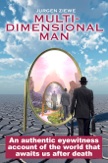
Book review: Multi-Dimensional Man, by Jurgen Ziewe

Multi-Dimensional Man, by Jurgen Ziewe


book review by Bob Peterson

Wow! Just...wow. Where do I begin?

This book doesn't follow the patterns of a typical OBE book. It doesn't try to train you to have out-of-body experiences. It doesn't try to tell you "this is how things work." The author is not out to convince you, win you over, teach you, or sell you anything. He doesn't even give you any OBE history. This is the story of one man's many journeys into the afterlife. Not in the Monroe-Institute- Focus-Level meaning of the word like authors Bruce Moen or Rosalind McKnight, but true out-of-body experiences, as I define them (where your body is just another inanimate object in the room). And his attitude is [in my words] "Here's what I saw: take it or leave it." (And I applaud him for that attitude.)

Unlike other OBE authors, Jurgen Ziewe (he's German, so it's likely pronounced Zee-Vay), wasn't even trying to induce OBEs. He was just practicing very deep meditation (for hours every day), and the OBEs were simply a bi-product. The reader almost gets the feeling that, for the author, the OBEs were a let-down; he was after much loftier goals, akin to Nirvana. He wasn't going to settle for anything less than God Him/Herself, but many times he got out-of-body experiences instead.

Several things impressed me about this book. First and foremost, the author makes it clear in nearly every OBE narrative that these were very conscious experiences. In many cases, he describes his awareness as hyper-conscious or super-conscious; his awareness was brighter and he was more alert than in waking life. He describes his experiences as having extreme clarity, even to the point of examining tiny scratches on surfaces. Like some of the OBEs in my own books, it's so realistic that at times he actually questions whether he's in-the-body. He has to do some gravity-defying feat to prove to himself that it's an OBE and not waking life. Clearly, these were not dreams.

Although he reiterated it with nearly every OBE narrative, the book really needed the repeated "reality" message: If it wasn't for the extreme level of clarity and focused conscious awareness, I would start to wonder if these experiences were lucid dreams (which tend to be more fantastic than typical OBEs.)

While we're on the subject, let's talk about lucid dreams for a minute. I've always maintained that the difference between an OBE and a lucid dream is that during a lucid dream, the scenery is a hallucinated construct of your own mind and you have complete control (in OBEs, it's not hallucinated and you have less control). Although Ziewe tries not to make such distinctions and lumps his experiences together, he can clearly tell when the scenery he's witnessing is "fake" or "real" and he notes it in his journal. And in his OBEs, he makes it absolutely clear that he's describing "real" places and events, not dream images. At times, it's so real that he worries he's invested too much of his consciousness in these places and won't be able to get back to his body.

While other pretentious authors might write authoritatively about visiting the third level of the astral plane, Ziewe's descriptions better match my experiences: There aren't any signs hanging over the doors (or pearly gates) that say "Astral Plane, Level 4, World 9, Continent 2, Section 8;" you just find yourself in unfamiliar surroundings and have to figure out where you are. I was particularly amused at some of his OBEs in which he goes around asking people, "What level is this?" And people look at him like he's crazy. These experiences give an air of credibility: Jurgen Ziewe is the real deal.

I might also describe Jurgen Ziewe as the "Eckhart Tolle" of the OBE world. Let me explain.

The first book I ever read by Eckhart Tolle was A New Earth, and when I describe that book to my friends, here's what I say: You have to give yourself time to absorb it because as you read the book, little coins of wisdom spill out all around you, almost as if by accident. It's like the author has pockets full of gold, and a hole in his pocket causes them to spill out as he walks, leaving you to pluck them off the street. It's like he's not even aware of the coins spilling out; like the wisdom is a completely unintentional bi-product of where he's going.

So when I say that Jurgen Ziewe is the Eckhart Tolle of OBEs, what I mean is: He describes these breathtaking, ecstatic experiences as if they're nothing special; just coins dropping to the floor. I can imagine myself having a comfortable conversation with Jurgen:
Bob: "Jurgen, if average people could just see what you've seen, it would open their eyes. It would change the world. It could end all wars. It could unite the religions. It could change the world!"

Jurgen: "Meh. Wasn't my intention. But wouldn't it be cool if..."
And he'd change the subject. It's comfortable, approachable and valuable.

How ecstatic are his experiences? Mind-blowing doesn't even begin to cover it. He pretty much runs himself out of adjectives and superlatives. Sometimes he describes the ecstasy or joy as crushing or shattering, using words like "unbearable glory." Here's an example:
"Curiously, the most challenging feeling to bear was the intensity of the joy I felt. I was unprepared for it. It was a joy synonymous with a blinding light, which became more intense and closer to pain the further I travelled inland, until I could not bear it any longer."
His first major experience, which led him to start meditating, was so touching I actually cried. The contrast between his OBEs and our ordinary waking life was like day and night. When this first major event ended, his:
"...room descended into the darkness of the bright summer daylight."

How's that for contrast? And that's just the out-of-body experiences; at the end of the book, he does get that Nirvana experience he was after.

He also does something else no other OBE book has: he travels back to past lives and actually experiences pieces of past lives from an OBE.

If this book had been written two thousand years ago, religion would have changed. People would have a completely different picture of heaven and the afterlife. Oh, people were having OBEs back then, and their descriptions live on in texts like the book of Revelation (of John), but the thing is, they were interpreted through a relatively primitive understanding of reality.

I'd say Ziewe's book is no less important than those religious texts. The problem is: people today are more jaded when it comes to religious experiences. For some strange reason, they disregard contemporary firsthand accounts as nonsense. They're more inclined to believe dogmatic religious accounts that have been altered by two thousand years of historical distortion and two languages of interpreter-distortion. Most people prefer ignorance over truth, and faith over knowledge. Go figure. I tend to think Ziewe's descriptions are much more accurate, and it does fit well with my experiences.

As for the writing: aside from a few typos, it's flawless; very well written.

The only think I didn't like about this book is that he didn't give any directions, tips or pointers for doing it yourself. He does, however, give some suggestions in an appendix regarding meditation and OBEs.

Thumbs way up. I highly recommend this book.

2013 Apr 08

Monday, April 1, 2013

Book review: Astral Projections by Michael Ross

Astral Projections by Michael Ross

Book review by Robert Peterson

Time for another book review. This time it's Astral Projections by Michael Ross. This one weighs in at 179 pages, and although the book is not as wide nor as tall as the previous two books I reviewed, at least it's a little thicker and uses a small font and no wasted space, so it felt bigger.

The book isn't so much an analysis of astral projection as it is a personal journey, and that made it quite endearing. The author is a retired Scottish schoolteacher, and his education shows: his writing is clear, highly intelligent, and even eloquent. As such, it resonated with me (I'm an excellent proof-reader and have often been accused of being a grammar Nazi). For example, I loved his description of the astral world as having a "delicious feeling and sensation of 'eeriness'." Even his occasional British and/or Scottish colloquialisms and conventions were endearing. For example, he references a "torch" instead of the American "Flashlight" I'm accustomed to.

Ross seems a lot like me, in many ways. Like me, he started his out-of-body journeys in the 1970s. Like me, he read the great OBE authors like Muldoon and Monroe. Like me, he checked out the religion of Spiritualism but never got in too deep. Like me, he investigated Eckankar and decided they were a cult. Like me, he investigated the Jane Roberts "Seth" material and found a lot of value in that. Like me, Ross wrote about an OBE encounter in which he met with a family member who had died. It was his son Murray, who had committed suicide, which sounds quite heart-wrenching. (In my case, it was my father).


Like me, he studied the great philosophers like David Hume and Charles Braud and many others. Although he expounded on their views of the OBE and how they came to their conclusions, he didn't really talk about how his own experiences supported or contradicted them, and that would have made the book better.

This OBE book isn't perfect. None are. I found his OBE narratives a bit disorganized and they didn't seem to serve any point in his story. Part of the problem is that he kept a journal of all his dreams, lucid dreams and OBEs, and wrote them all down in the same place. Some of this is reproduced in the book, but it was hard to tell what was what. I wanted more narratives, but unique stories that made a point.
The first half of the book was, in my opinion, much better than the second. The first half had the freshness of discovery. The second half had a certain amount of redundancy; it reiterated several points and narratives from the first half. He even revisited the philosopher CD Braud a second time (even the first iteration was a bit much.)
One of the things I liked about this book is Michael Ross's brutal honesty and self-criticism. He's not trying to make himself out to be a guru or an expert at OBE. He admits his flaws and shortcomings. He admits his laziness. The OBEs in the book had a huge impact on him and his life, but as an experiencer myself, I had hoped for something more groundbreaking.

This book is one man's journey of OBE discovery. It's not Earth-shaking or profound, but it is endearing and entertaining. I'm giving it a thumbs up.

2013 Apr 01