Tuesday, January 11, 2022

How to Focus Your Mind For OBEs

How to Focus Your Mind For OBEs

by Bob Peterson

Someone recently asked me, "What's the right frame of mind to induce OBEs? What kind of mindset should I have?" It's an excellent question and one that requires a lot of attention. It's kind of hard to explain. I wrote three different chapters of my second book, Lessons Out of the Body, on the subject. They were:

  1. Chapter 22. "How OBE is Like Tightrope Walking"
  2. Chapter 26. "Keys for Inducing an OBE", and
  3. Chapter 28. "State of Mind Required to Induce an OBE"

Of the three, only chapter 26 is available on my website (see link above). But since Lessons is out of print and hard to find, I thought I'd draw on those chapters for this article.

Focus versus concentration

Inducing an OBE requires focus, and lots of it. It's like walking a tightrope. You need to stay focused on the goal and getting there. That's different from "concentration." A tightrope walker doesn't "concentrate" on getting to the other side. He or she does has the intense focus required to balance and keep moving forward to achieve the goal. He or she doesn't look down. He or she doesn't worry or even think about falling. They have a focus free of distractions, single-minded, goal-oriented and pointed in one direction. That's what you want for an OBE.

Shut out distractions

To attain an OBE you cannot be nervous, anxious, afraid, or sleepy. You cannot be distracted by bodily needs or cravings like hunger, thirst, and itches. You can't anticipate the future or dwell on the past. You cannot distracted by alerts on your phone, text messages, emails, excessive noises or other attention-grabbers. In fact, it's probably best if you put your phone in "Do not disturb" or airplane mode when you practice. Your attention needs to be completely focused inward, in the present moment. You need to shut out the external world and focus completely on internal events.

Reduced thoughts and feelings

You can't be distracted by your own thoughts, like "Am I doing this right?" "How long should I do this before I give up?" "What should I eat for dinner?" "If I'm successful, what could happen?" You need to let all that go, relax your mind (and body) and focus on doing one thing: pointing your mind in that single direction.

You shouldn't be emotional, either positive or negative. Frank Herbert, author of the Dune books famously wrote, "Fear is the mind killer." Fear is also the OBE-killer. You should not be sad or happy, anxious or elated, fearful or brave. In fact, you should aim to just "stare off into space" with a blank mind. You should strive to be "the dispassionate watcher" instead of a "doer": Just watch and see what happens next. That's what many authors describe as a "trance."
 
Don't aim to "do" an OBE technique as much as to "watch" what unfolds when you slow down and focus your mind inward.

Absorption

Absorption is the ability to shut out external influences to remain focused. For example, you can be "absorbed" in a book, like when you become so engrossed in reading that you don't even notice someone talking to you. Try to become so absorbed in your OBE technique that you don't notice external stimuli like noises.

Watch and own hypnagogic images

One of my favorite techniques is to approach the edge of sleep and wait for hypnagogic images (hallucinations) to start drifting past your mind's eye. This will happen even if you're terrible at visualization: you just need to remain conscious long enough to see it. Watch those hypnagogic images dispassionately, but never lose focus on them. Never play "what if" with them or you'll get sucked down into sleep.
 
Try to assume ownership of the images. If you see a baseball bat, tell yourself "It's my baseball bat." If you see a bowl of soup, tell yourself, "It's my bowl of soup." If you see an Imperial Battle cruiser, tell yourself, "It's my battle cruiser." Try to examine the object closely for as many details as you can and, if possible, imagine touching it and feeling its texture. Do this for any hypnagogic image until it disappears, disintegrates or fades away, then wait for the next one to appear. The longer you do this, the more solid and real the images will seem.

Realism

Try to develop this sense of realism. In other words, try to convince yourself that the things you see in your mind's eye (whether they're imaginary or hypnagogic hallucinations) are real. Tell yourself they're real, even though you know for sure they're not. The more "real" you make the hypnagogic image seem, the more your brain turns its attention away from your body's five senses, and that is the key to getting out-of-body: You need to trick your mind into letting go of its stubborn "in-the-body story of experience."

Letting go

Once your mind lets go of the "in-the-body story of experience" you will either pop right into the out-of-body state or the vibrations will sweep into your body.
 
One you're fully out-of-body, you will experience the OBE state in real time. You then stop all pretending, stop all visualizations, stop all hypnagogic hallucinations, stop all use of your imagination. Often the images will stop automatically and you'll be "zapped" into a hyper-aware state of focused consciousness.
 
From that point, simply sit up, stand up, or otherwise try to leave the bed (or chair) the same way you would physically. If you're in the right state, your physical body should be in sleep paralysis and not move at all. Your non-physical (or "astral") body will be the focus of your experience. From there, simply go out there and explore the out-of-body state.
 
Bob Peterson
11 January 2022

Tuesday, December 21, 2021

Review: Man Outside Himself

Review: Man Outside Himself

by H.F.Prevost Battersby

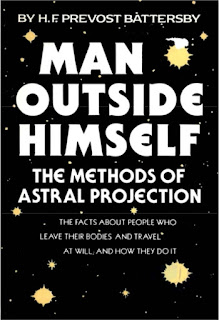
Today I'm reviewing the book Man Outside Himself: The Methods of Astral Projection by H.F. Prevost Battersby. The copyright is from 1969. The book has a second subtitle: The Facts About People Who Leave Their Bodies and Travel At Will; And How They Do It. The book is very hard to find in print, but can be easily downloaded (I think for free).

Since I started investigating astral projection/out-of-body experiences in 1979, this was one of the first ten books I bought, but it didn't have much advice for learning to induce OBEs. There are several casual mentions like, "When asked how he did it, John said he didn't know." Not real helpful. There were a few scant mentions of techniques, but it's all pretty basic stuff: calm and focus your mind and relax your body, and so on. The best set of instructions was this:

"The essential points for study are: The power to concentrate one's thoughts on a single object without being distracted by outside stimuli; the practice of rhythmic breathing; nervous and muscular relaxation; and, finally, the ability to suspend thought completely." (pg. 89)

I agree with all that, but it's still very basic.

The book does have a lot of OBE narratives and if you follow my blog, you know how much I love narratives.

Battersby also has a lot of really cool out-of-body history in the book. He talks about the earliest reports of astral projection/OBEs in modern times, and some of the most verifiable. The study of astral projection in modern times began when Ralph Shirley wrote articles for a periodical called The Occult Review in 1907. In 1920 Shirley published a narrative from one of the earliest pioneers of the subject, Oliver Fox. Eventually in 1938 Shirley published a book titled The Mystery of the Human Double. Battersby talks about Fox, Sylvan Muldoon, Yram, Charles Lancelin, and many of the other early astral projectors. He also talks about the Theosophists like H.P.Blavatsky and A.E.Powell, and about mystics like Emanuel Swedenborg.

Many of the OBE narratives quoted in the book are excerpts from another famous book, Phantasms of the Living, written by three founding members of the Society for Psychical Research (SPR): Edmund Gurney, Frederic Myers and Frank Podmore. In many cases the apparition of a living person was seen by someone else. Not all of them were out-of-body experiences: some were cases of autoscopy (dopelganger), and Battersby addresses that subject in the book as well.

Here's one of my favorites: In 1891, a woman named Mrs. Butler was living in Ireland with her husband, but for years she kept "dreaming" she was in a beautiful house. It was quite literally her "dream house." Later, when the couple moved to London, they found the actual house. She said, "Why, this is the house of my dreams!" and they bought it. When the housekeeper saw Mrs. Butler the first time, she exclaimed, "Why, you're the ghost!" She then explained that the house had the reputation of being haunted and she had apparently seen the non-physical body of Mrs. Butler many times. (pg. 49) I absolutely love stories like this, and this book contains many like it.

In another case, a woman named Hermione P. Okeden claimed she could leave her body, so her friends challenged her to visit in the out-of-body state and describe the details of their homes. The friends tried several times to fool her, even rearranging furniture in the houses, changing clothes, and tried to confuse her in other ways, but her descriptions were always accurate. (pg. 64)

Battersby also talks about an often overlooked astral traveler, Vincent Turvey, whose out-of-body adventures were documented in the book, The Beginnings of Seership. (I loved that book, but haven't book reviewed it yet.) What makes Turvey unique is that he would travel out-of-body to visit spiritualist seances across town and use the spirit medium's body to do automatic writing, signing his own name. On at least one occasion he even claimed to take control of the medium's body, talk through his or her vocal cords, and so on. Turvey's book contains reluctantly signed testimonials of several eyewitnesses who were at the seance and saw it happen. Note that Turvey had medical conditions that made it virtually impossible for him to cheat or even attend the seances in-the-body.

I loved this book. On the plus side, most of Battersby's OBE narratives had third-party verification. It's pretty convincing stuff. On the minus side, the narratives are all pretty old, from the 1800s and early 1900s, which is often enough to make hardened skeptics like Susan Blackmore discount them completely. There aren't any solid astral projection techniques.

Battersby has done a ton of research here. The writing is professional and the book is 100 pages, with tight margins and a very small font, so there's a good amount of content. But the information is very old, and you won't find any OBE techniques in there. I'm giving the book 3 and a 1/2 stars out of 5.

Bob Peterson
21 December 2021
----------------------------

If you want me to review a book about out-of-body experiences or astral projection, send me an email: bob@robertpeterson.org, but please check the index first to see if I've already reviewed it. Also, I've got a huge pile of books I'm planning to review, so don't expect a quick turnaround.

If you like my work, visit my website, robertpeterson.org, where you'll find lots of other free OBE advice and links.
Return to the index of my OBE Book reviews


Tuesday, December 7, 2021

Harley Davidson's OBE Secrets

Harley Davidson's OBE Secrets

by Bob Peterson

Like many of my blog articles, this one is about learning to induce out-of-body experiences/astral projection, but there's a story that goes with it, so bear with me.

Buying a Harley Davidson

I had some PTO to use before the end of the year. With cheap airfare, Kathy and I flew to Colorado to do some sightseeing and visit relatives in Arvada (home of author Vicky Short--Hi Vicky!).

One day, while Kathy toured a historic hotel in Georgetown, Colorado, I went to the public library and surfed the Internet. I've owned and ridden many motorcycles in my life, and in late August, 2021 I decided to buy a Harley. So I did some searches to see if used Harleys were cheaper in Colorado. They were! I found a good deal on a particular bike in Fort Collins, so we drove up there and bought it. But then I had to get it back to Minnesota.

Road trip!

A few weeks later, we took another cheap one-way flight back to Colorado to pick up the motorcycle and drive it home. Since the vast majority of motorcycle accidents happen in the first 100 miles of ownership, we decided to take it easy, avoid freeways, only drive 4 or 5 hours a day, and avoid driving in the dark when possible.

We didn't have a charger for our wireless helmet headsets (the manufacturer didn't include a power brick--what kind of crap is that?) so were pretty much out of battery life on our first day. They also had an old level of firmware, which was buggy, and caused annoyingly loud feedback. To make matters worse, the Harley had very loud exhaust pipes (which I've since changed out). Bottom line: I couldn't hear Kathy, the radio, or the GPS even when they did work, so I didn't even try. So although Kathy was right behind me, we didn't talk. I was alone with my thoughts. I tried to avoid "highway hypnosis" by shifting my attention from item to item: traffic, rear-view mirrors, gas gauge, GPS map, handlebars, and occasionally the lyrics of obscure songs that came to mind. There was plenty of time for introspection and talking with my "inner voice."

One night, a few days into the trip, I'd just spent five hours driving down rural highways, past cow pastures and an occasional cow, alone with my thoughts and the constant rumble of the Harley. Tired, we checked into a hotel in the middle of rural Nebraska. It was late, and the room had two separate Queen-size beds. I changed into pajamas (or if you're British, pyjamas--I love that spelling!) and climbed into bed.

Bam!

As my head sunk into the pillow and I began to relax, I thought about the low rumbling noise of the Harley, and almost immediately I was inundated by "The vibrations" that precede some of my out-of-body experiences. They swept suddenly and intensely into my head and then throughout my body.

After 42 years of out-of-body experiences I don't get the vibrations much anymore, but once in a while they still come before my OBEs, and usually they're pretty mild. This time they hit so hard, fast, and intense that it startled me. These were the fastest OBE vibrations I've ever had. I was so shocked I snapped right back out of it, unable to convert it into an OBE. Doh!

The next day, as we continued our trek back to Minnesota, I reflected on what was so different from "normal" days in my life. What had caused this sudden, intense vibrations?

What it wasn't

I was certain it wasn't caused by the unfamiliarity of the hotel. In past articles I've written about "Harnessing Unfamiliarity For OBEs" and how staying in strange hotel rooms can often trigger OBEs. But that sense of "Sleep with one eye open" (to quote Metallica) wasn't with me that night. My head had barely touched the pillow! This hotel room was nothing special; an ordinary room in the middle of no where Nebraska.

Contributing factors

So what was different about that day?

Alone with my thoughts

That day, and the few days prior, I was mostly left alone with my thoughts. I had a lot of time for quiet introspection. In other words, I exercised my Default Mode Network (DMN), focusing on inner events more than outer events. I had also been away from work, a welcome break from the analytical thinking required for my job.

Little communication

Throughout the day, Kathy and I talked at gas stations and meal time, but other than that, there was very little opportunity to talk.

Just water (and coffee) to drink 

In an average day, I often consume a variety of drinks: almond milk with cereal at breakfast, a self-made coffee drink, water, maybe some juice. On this day it was straight coffee with coffee creamer in the morning and water the rest of the day.

Absolutely no artificial sweeteners

I've always maintained that my OBEs are more plentiful when I'm more trim. To lose weight in recent years I'd started using artificial sweeteners. I've always avoided aspartame (Nutrasweet) and Saccharin because I think they're not good for you. I avoid Stevia (Truvia) because I don't like the taste. But I still used sucralose (Splenda) and Monk Fruit. For example most of those "Mio" flavor squirts for water contain sucralose. However, on this trip our options were very limited. That morning I sweetened my coffee with a little real sugar, and hadn't consumed any artificial sweeteners for three days. Maybe artificial sweeteners are counterproductive to OBEs and had worked their way out of my body?

Wheat gluten every meal

I've written elsewhere that I believe wheat gluten can assist in out-of-body work. So I took note of the fact that I had eaten wheat gluten every meal that day. I hadn't planned it, but before we left the hotel in the morning I ate one of those hotel waffles (I love that Jade Shaw's dog is named Waffles--Hi Jade!). At lunch, I had eaten a sandwich with a bun. For dinner I had eaten a chicken sandwich or something. So maybe the vibrations were partly due to an accumulation of wheat gluten in my system.

Longer periods on an empty stomach

My job as a computer analyst requires intense brain work, and I find it easier to focus if I'm not distracted by hunger or rumbling in my stomach. Plus I think my body craves carbohydrates to bring more glucose to my brain. So between meals I often eat small snacks like a granola bar or a handful of cashews or almonds. However, on the day of the vibrations, I spent the whole day driving, which meant there was no time for snacking. I was held to three meals, nothing more. So my digestive system was on more of a roller-coaster--mini fasting between meals--rather than constantly processing food.

Yogurt

I've written elsewhere that a healthy gut microbiome (friendly gut bacteria that help us digest food) can make OBEs more likely. Conversely, OBEs can be harder with constipation. On the day of the vibrations, I had eaten a cup of yogurt for breakfast, which is known to be good for the gut microbiome, and no nuts.

Attention exhaustion

On a motorcycle you need to be especially cautious. Riding on the day of the vibrations, I had been staring straight ahead, eyes on the road, looking for deer and other animals that might jump out in front of the motorcycle. So my attention was intensely focused for hours, causing some attention exhaustion.

Rumble-memory

On that day I heard the rumbling of the motorcycle and felt the motorcycle's (physical) vibrations for hours. As I lay back, the memory of the sound-coupled with vibrations was fresh in my memory.

Not sleeping next to my wife

That night our hotel room didn't have a king-size bed; it had two queen beds. So I slept in a bed separate from Kathy. Many people (including author William Buhlman) say that it's harder to induce an OBE when someone's with you in bed. Buhlman told me he thought it was due to the overlapping of the people's auras. Regardless, it may have been a contributing factor.

Long-term sense of motion

I spent that day constantly in motion; driving down the road. That constant sense of motion may have been a contributing factor too.

No music

I'm a music lover and have been all my life. But in one of my early OBE journals I once made an observation that I'm more likely to have an OBE if I don't listen to music the entire day before. So I sometimes refrain from listening to music so OBEs are more likely. Since the Harley's radio was overpowered by the noise of the tailpipes, I didn't even try to listen to the radio that day or the day before.

Other differences

  • I had natural sleep cycles the night before: I hadn't been awoken by an alarm. 
  • That morning I had drank coffee, but only after I'd been awake a while.

All of these factors may have contributed to my entering the vibrations so instantly that particular evening. Then again, some of them might boil down to superstitions and beliefs: your belief creates your reality. So maybe I'm just conditioned to think that these things will help. But it never hurts to try, right?

Things to try

So if you want to induce OBEs, here are some things to try based on what I learned from my Harley Davidson road trip:
  • Eat at least a small amount of wheat gluten in your daily meals.
  • Eat conservatively: Don't snack between meals.
  • Be friendly to your gut microbiome: eat some yogurt or drink a small amount of kefir, and reduce your intake of foods that give you constipation, like nuts.
  • Don't listen to music the day before.
  • Sleep alone in bed.
  • Avoid all artificial sweeteners for at least three days.
  • Spend less time speaking with people and more time in introspection.
And if all else fails, take a motorcycle trip through rural Nebraska!
 
Of course, none of this will guarantee you an OBE. You still need to do the work. You should still practice the 7 Habits of Highly Effective Astral Travelers. All these things may help make OBEs more likely in your life.

Bob Peterson
07 December 2021

Tuesday, November 23, 2021

The WILD Way To Lucid Dreaming

The WILD Way To Lucid Dreaming

by Slider

Today I'm reviewing The WILD Way To Lucid Dreaming: Waking. Induced. Lucid. Dreaming. Lucid Dreaming On Demand by Slider. The copyright is 2016.

I normally don't focus on Lucid Dreaming books. After all, I've still got plenty of astral projection and out-of-body books in my library to hold my attention. But this book intrigued me, so I had to buy it and read it.

Who is "Slider?" I don't know, but maybe the pen name was taken from the 1995-2000 television show, Sliders, in which a small group of people travel or "slide" from dimension to dimension, finding adventures and trying to find their way back home to "our" dimension. Sounds about right.

We all know a lucid dream is a dream in which you're conscious and completely aware that you're dreaming. It's also a convenient jump-off point to out-of-body experiences, and therefore isn't out of place in my blog. If you already know how to induce lucid dreams, click on this link for an article I wrote about converting lucid dreams into OBEs.

If you're still learning to induce lucid dreams, you should know there are basically two approaches: DILD (Dream Induced Lucid Dreams) and WILD (Wake Induced Lucid Dreams).

With DILD you condition yourself and alter your habits so you more easily discover when you're dreaming, by doing reality checks ("Am I dreaming?"), reminders, mnemonics, flashing light masks, and other tricks of the trade.

This book is entirely about the WILD approach to lucid dreaming, which is to induce a lucid dream from the onset of sleep: you consciously choose to go into the dream, starting from full consciousness and ending up in a lucid dream.

The book is broken into several parts.

Part 1 is "Theory" which is just the basics: what lucid dreaming is, degrees of lucidity, why should we do it, etc. Unfortunately, I found this section somewhat repetitive or tedious. Slider repeats over and over how WILD is superior to DILD. After all, DILD takes a lot of time and training to be any good at it, it's hit-or-miss and you have less control. The larger dreaming community seems to think that WILDs are much harder than DILDs, but Silder disagrees. He claims WILDs are easier to learn, you can enter into the lucid dream with your full waking memories, and you have much more control. But he seems to harp on it just a little. I admire his enthusiasm but by the end of the section I was getting impatient and ready for some real substance. This section takes up roughly a third of the book.

Part 2 is "Practice" and this is where the book gets interesting. This is where Slider explains how to induce a WILD. The first chapter of this section is titled "Hypnagogia: The Key to WILDs." His technique is very similar to the out-of-body technique that I favor, and have taught. This is what makes it relevant to out-of-body experiences. It's so important I'll quote the book:

"All one really has to do in order to start lucid dreaming, is to learn to recognise the stages of falling asleep, find this hypnagogia on the way into it and then treat these hypnagogic images in a very particular way. Ultimately, it is through hypnagogia that one actually enters into an altered state at all and lucid dreaming in particular...when you want to lucid dream, then all you do is to watch that same [hypnagogic] movie show again, only this time treating those hypnagogic images by examining their detail in a particular way.
This conscious act of examining a hypnagogic image's finer detail is the very thing that finally beckons one right into a lucid dream. One is somehow bodily zoomed in, or rather, pulled into the image itself resulting in dreams in which one is already awake. Not examining the details of those images while just letting yourself drift as usual results in one eventually nodding-off and having very ordinary, non-lucid dreams... and really that's all there is to it. A simple choice!" (pg. 60-61)

By the way, this is really the only "WILD" lucid dreaming technique Slider has in the book. Elsewhere he gives some advice for inducing DILDs, but he plainly states that it's not his focus and there are better books on DILDing.

Compare this to my favorite OBE technique

Now in my favorite out-of-body technique, for example, the one I teach in this blog article, I recommend the following:

  • At some point you will see/hear [hypnagogic] imagery.
  • Do not get drawn into them.
  • Do not take interest in them.
  • Do not pretend "What if" with them.
  • Maintain conscious awareness.
  • Take control of an image.
  • Move the object or spin the object.

Elsewhere I've also said:

  • At this point the hypnagogic image is likely to dissolve or vanish.
  • When that happens, just wait patiently for another to appear, then do the same: take ownership of the image. Tell yourself, "This is my object."
  • Hypnagogic images at the onset of sleep are more likely to dissolve, but as you get further into sleep, they should become more stable, realistic, life-like, and longer-lasting.
  • If a hypnagogic image is too big or complex to move, spin, or manipulate, like a soccer stadium packed with people, just take ownership of it and watch it passively until it disappears, and in a few seconds, the next one will appear.

In my OBE technique, I imagine a strong force like gravity pulling me toward the object and out of my body.

So what's the difference?

Slider's WILD technique is indeed very similar to my OBE technique, although IMHO he doesn't describe it in enough detail. In Slider's technique, examining the hypnagogic image draws you into the lucid dream state. Apparently you merge with the hypnagogic imagery and it becomes a lucid dream. In my technique, the hypnagogic imagery is simply used as a device to draw you away from the body. Or as I wrote elsewhere, to "derail" your in-the-body "story of experience." You are not sucked into the hypnagogic image, its dream elements, its dream setting or its dream story. You just feel a blur of motion, then usually all motion stops suddenly and you find yourself lying inside your physical body, fully conscious and aware, but separate from it. This is usually when the vibrations come sweeping through your body.

Other advice

Slider also offers some sound advice that applies to both WILDs and OBEs. For example, he says to relax completely and tweak your body's position to find a state of complete relaxation, then it's important to not move again.

Here's another sound piece of advice:

"Once you've reached this floating feeling of relaxation, the next step is to absolutely and deliberately turn your attention completely away from all any sensations of the body altogether, totally ignoring them. Having served their purpose they are no longer important. Peer instead at the blank dark screen you can see just behind your closed eyes. Don't move at all and hang onto that feeling of lightness or floating and stare at the darkness that's right there in front of your face until you begin to notice the odd blob or streak of colour appearing and disappearing at random." (pg. 65-66)

And later:

"Watching these really clear images for any length of time (a marvelous experience though it is) always leads to falling away into normal sleep. On the other hand, if you instead stare at one of them and attempt to examine the finer details of it, something very strange happens; the sensation of what can only really be described as a kind of "zooming-in" -- and then you'll suddenly find yourself in a lucid dreaming state." (pg. 69)

He also says that his technique leads to lucid dreaming "daily."

Levels of Lucidity

The book has an interesting section in which he describes several levels of lucidity. In each level, lucidity seems to be more difficult to maintain.

  1. In the first level, the only person in the dream will be you and you alone.
  2. In the second level, you may see some people but usually don't interact with them.
  3. At level three, lucidity drifts in and out in waves, but you still know that you're dreaming. You can forget what you were doing and find yourself drifting off into daydreams, then coming back again.
  4. Level four is a "full lucid dreaming scenario" where anything can happen.
  5. Slider hesitates to call this level 5. He prefers to call it "level zero". In terms of awareness, it seems to be a middle-ground between waking and dreaming.

One chapter is devoted to changing dreams. Many lucid dreamers insist you can consciously manipulate the contents of a lucid dream. Lucid dream expert Robert Waggoner points out this is often not the case: lucid dreams often have a mind of their own and defy attempts to change them. Slider insists lucid dreams are easy to manipulate. If you want to fly, just jump up and fly. For what it's worth, I can usually manipulate my experience in lucid dreams.

Part 3 is "Advanced Techniques"

I was enthralled by this chapter because Slider brings up some very interesting observations. For example:

Recommended body position

Most authors of astral projection and out-of-body books insist that lying on your back is the most effective position. Slider recommends inducing WILDs while lying on your left side. He notes several qualitative differences with other positions, with left-side dreamers having more control and stability. He writes:

"Anyway, with left-sided dreams one is apparently very much in control of the dreaming situation from the outset, with the option of changing dreams. Everything from the left side in dreaming is smooth, thus making it the perfect starting off position for newbies to have their very first, real, full lucid dream. In left-sided lucid dreams you feel fully awake and aware and every respect, which gives you time to manipulate your next moves judiciously and put into action any experiments you may have had in mind." (pg. 111)

Contrast that to right-sided lucid dreams:

"While sleeping on the right side, the dreams seem to change all by themselves without any warning or choice on the dreamer's part. Do nothing other than observe in a right-sided dream and you will find yourself going (or hopping) from one lucid dream to another in quick succession....
In right-sided dreams, by contrast, the dreams themselves are far more complicated. You'll be presented with a series of often novel and very compelling dreaming situations that almost force you to interact with them. Lucidity is still full, as is full waking memory, but in these dreams there's no real volition as to what you'll be dreaming about or the situation you will find yourself in. Furthermore, the dreams themselves tend to change from one situation to another very quickly without giving the dreamer any time to adjust as you barely have time to get used to one novel dream scenario before being hurled off into another." (pg. 112-113)

Slider also has some interesting observations about how sleep is a necessary part of life. For example, you can have severe problems if you're denied the dreaming phase of sleep. What about lucid dreams? He says that lucid dreams are even more refreshing than ordinary dreams. He comes back feeling very energized. In fact he says:

"This brings us to another noteworthy point; that another emerging but undeniable fact about lucid dreaming is that even the slightest contact with the lucid dreaming state results in what can only be called a thorough refreshing of whatever it is that makes us feel tired in the first place. If actively a mere forty-five or ninety minutes of 'lucid' dreaming is noticeably more physically restoring than a whole night's worth of ordinary sleep and dreams." (pg. 129)

Contrast that to many OBE authors who insist that OBEs require a great deal of energy, and they come back feeling drained. Full disclosure: OBEs have always left me energized.

So are OBEs just Wake Induced Lucid Dreams?

Slider addresses this question directly. He joins the swelling ranks of experts like Robert Waggoner who insist OBEs and Lucid Dreams are not the same thing, as Stephen LaBerge once wrote. Slider writes:

"This [astral projection / out-of-body experiences] is something completely different to lucid dreaming, although at times it does indeed feel like you have been from your body in the sense that, with WILDs you can still feel your body lying down in bed whilst still dreaming." (pg. 147)

I liked this book. I'm not entirely sure why, but I really liked it.

On the down side, the book doesn't really say much: it only gives one concrete technique for inducing lucid dreams, and almost no lucid dream narratives to indicate the author's level of experience. Still, it was honest and tidy. It talks about the lucid dream in very concrete and relatable ways. On the up side, it's honest and no-nonsense.

The book is 159 pages, with a small footprint, but the tight font and close margins compensate to give you a satisfying amount of material. The writing starts a little immature, but by the end of the book he comes off as both knowledgeable and sophisticated.

I'll give the book 4 stars out of 5.

23 November 2021
----------------------------

If you want me to review a book about out-of-body experiences or astral projection, send me an email: bob@robertpeterson.org, but please check the index first to see if I've already reviewed it. Also, I've got a huge pile of books I'm planning to review, so don't expect a quick turnaround.

If you like my work, visit my website, robertpeterson.org, where you'll find lots of other free OBE advice and links.
Return to the index of my OBE Book reviews


Tuesday, November 2, 2021

Review: Astral Projection and Psychic Empowerment

Review: Astral Projection and Psychic Empowerment

by Joe H. Slate, Ph.D.

Today I'm reviewing Astral Projection and Psychic Empowerment by Joe H. Slate, Ph.D. The subtitle is Techniques for Mastering the Out-of-Body Experience. The copyright is 1998.

Like all books about astral projection, this one has both good and bad. Like the previous book I reviewed (Astral Projection by Michael Marr), this book is heavy on techniques, but the author doesn't really say where or how he obtained his knowledge. It's another knowledge dump. However, Slate is a Ph.D. and shows higher intelligence than a lot of them. It also means the book is more clinical, sterile, even a bit tedious at times. But it's still good material.

I liked this quote from the introduction:

"Although OBEs have at times been over-dramatized, romanticized, and even trivialized, they have never been more relevant to our personal growth and empowerment than today." (pg. xii)

Absolutely. I also liked this quote:

"In developing our out-of-body skills, there can be no substitute for practice. Even experienced out-of-body travelers find that practice is essential in fine-tuning their old strategies and mastering new ones. Only through practicing various approaches can we discover those techniques that meet our personal needs and work best for us individually." (pg. 21)

Like me, Slate favors techniques that involve an imagined sense of motion. For example:

"Preparatory OBEs exercises often include practice in creative imagery, particularly emphasizing motion. Slow moving clouds, a leaf in the breeze, a sail at sea, or even a magic carpet ride are good examples." (pg. 23)

His preliminary exercises are basic but solid:

"The induced disengagement of the astral from the biological is typically initiated by first allowing the physical body to become deeply relaxed and then, with the eyes closed, clearing the mind of active thought." (pg. 23)

The good news is that this book is heavy on techniques. Slate gives several, listing them, in part, as:

"Among the most highly effective of these strategies are OBEs Levitation, Astral Walk, Mirror Image, and Astral Surfing. Interestingly, gender differences in the effectiveness of these procedures have been noted, with women typically more responsive to Mirror Image and men typically more responsive to Astral Walk." (pg. 26)

Slate then goes on to give more details about each of these techniques. Unfortunately, I still found his techniques a bit lacking. Slate is a professional hypnotist, so his techniques are a bit repetitive. They mostly sounded like this to me:

  1. Relax your body, slow your breathing, and focus your mind.
  2. Steps 2 or 3 are something like "Envision that you're out-of-body."
  3. Step 3 or 4 are usually "do something" after you're out-of-body.
  4. Return to your body.

He makes it sound easy like you can snap your fingers and be there. And maybe it is that easy for some people, especially people are easily hypnotized. But it's never been that easy for me.

Step 1 is basic: You need to be completely and totally relaxed and focused. He gives several different variations of step 2, such as this quote from "OBEs Levitation":

"2. Focus your full attention on your physical body and imagine it becoming lighter and lighter, until finally, it seems to become weightless. 3. As the sense of weightlessness continues, imagine your physical body, as light as a feather, beginning to rise slowly. Next, envision your physical body momentarily suspended in space, then slowly returning to its original position, but leaving your consciousness behind in astral form, still suspended over your physical body." (pg. 27)

That's it. While he makes it sound easy, I want more details. Perhaps it's my own shortcomings. I am, after all, an analytical computer guy who wants his head in the bits and bytes. Slate actually goes into a fair amount of detail on a lot of his techniques. I just found them...somehow lacking. Here's a good example from one of Slate's techniques:

"To induce the out-of-body state, slow your breathing and clear your mind of all active thought by focusing on the white screen. After a few minutes of focusing, close your eyes and envision your physical body at rest. Continue to envision your body resting peacefully until you sense yourself becoming separate from it. Stay with that sense of separateness, letting yourself gently float away from your body..." (pg. 48)

See what I mean? Sounds like you're supposed to just sit there and envision your physical body at rest until--poof--you're there. For me, it's never been that simple.

Here's another example:

"Out-of-Body Induction. With your body now fully relaxed, envision yourself so liberated from the pressures of life that you begin to drift gently upward like a white vapor, away from your physical body, leaving all your cares behind. Notice the sense of freedom and wondrous release from your body, which is now at rest below you." (pg. 70-71)

I feel like he's missing a step. I mean, yeah, sometimes that's all it takes. But I've spent countless hours quiescing my mind and "just waiting" for it to happen and it usually gets me nowhere. It reminds me of this well-known comic:

I shouldn't be so hard on Slate. At times, he tries very hard to go into more details. For example, this excerpt from one of his exercises is much more helpful:

"Out-of-body induction for this procedure begins by generating a focused mental state through imagery of a surrounding space filled with light, but devoid of color, shapes, or movement. A strategy called astral polarization is then used to induce the out-of-body state. Polarization is initiated by a physical and mental clearing exercise that sets the stage for this out-of-body state. Imagery of the physical body as a sponge soaking in relaxation is recommended for physical clearing, while envisioning the astral body as a tranquil energy form, filled with light, is recommended for mental clearing.

As relaxation and tranquility deepen, the physical body becomes progressively heavy with relaxation, while the astral body becomes increasingly buoyant with tranquility. The result is the polarization of the astral and biological bodies, and a slow separation of the two." (pg. 106)

Now that is the kind of information I want.

To his credit, Slate gives a wide variety of astral projection techniques, including how to use self-hypnosis to achieve it. If you're susceptible to hypnosis, many of his techniques might work well. Unfortunately, only 10 to 15 percent of people are easily hypnotized.

Slate does make some dubious claims, such as:

"In its highest and most elegant form, out-of-body PK could either repair a damaged organ or literally recreate a new one. Conceivably, this is one of the most important yet most neglected, health and fitness resources of our time." (pg. 10)

Here's another claim that sounds a bit dubious, even for me:

"Central to ATS (Astral Telepathy System) is the Astral Blue Beltway, a fluid stream of psychic energy used to convey telepathic messages." (pg. 41)

Sorry. I shouldn't poo-poo this. After all, many reasonable scientists conclude, after 100 years of experiments, that telepathy is a fact. And many have suggested the information transfer relies upon principles of quantum physics such as quantum entanglement or some kind of quantum field. Calling it a "blue beltway" may sound hokey, but it may not be too far off the mark.

Slate also suggests that sexual partners can temporarily swap bodies, which is an extremely rare and dubious claim in OBE literature:

"At this critical point in the procedure, each partner first envisions, then astrally engages, the biological body of the other partner. In the male-female dyad, the astral male assumes a female biology while the astral female assumes a male biology, resulting in a gender reversal state which we could call out-of-one's-own-body-but-in-the-body-of-the-other." (pg. 79)

Bear in mind this was written long before the Netflix show Behind Her Eyes. Maybe the show got some of its ideas from Slate?

On the positive side, Slate talks about using astral projection for many different things:

  • "Extrasensory expression" (I assume he means ESP or clairvoyance.)
  • Healing yourself.
  • Meeting with astral guides and angels.
  • Meeting with friends, relatives, and pets who have passed away.
  • Exploring past lives. Curiously, he treats past lives as chronological. In other words, you cannot visit future lives because they haven't occurred yet. Many other books claim OBEs are beyond time, and our lives from other reincarnations coexist simultaneously, past, present and future.

Slate also goes into great depth about different colored (or "coloured") astral planes, one for each color of the rainbow, that serve different functions: for example, one is more geared toward healing, etc.). He says to get to any particular one, just focus on it and imagine yourself there (once you're out-of-body). To take advantage of a colored-plane's special property is something he calls "Astral Outsourcing" and he gives instructions for each one. Again, I'm skeptical about this. I've never seen a "blue" or "orange" astral plane, and why should they be limited to the colors seen by human eyes when we're not using our physical eyes and the electromagnetic spectrum is infinite? Why isn't there an infrared astral plane? Or an ultraviolet one? Not to mention a gamma ray plane, x-ray plane, microwave place, etc. You get the idea.

Chapter 10, "OBEs in the Laboratory" is an absolute gem. Slate gives a number of interesting lab experiments he's supposedly conducted, mostly using volunteer college students. For example, he talks about using Kirlian photography to study the effects on the biological energy field during OBEs. He gives several example photos, and most show a uniform (even) energy pattern surrounding the fingertips before an OBE, but during the OBE, the energy has a "broken corona" effect where the energy appears broken into two separated sections around the finger. This broken corona effect lasted for the full duration of the OBE. (Pg. 136-138).

Slate did an experiment in which students used out-of-body travel to identify a remote target, in this case, a model train. A couple of the travelers supposedly correctly reported the train's manufacturer, which was printed in white letters on the side of the engine. (pg. 144)

He supposedly also found, through lab experiments, that ESP was greatly enhanced during OBEs. In one experiment, technicians traveled out-of-body to a different room in which they took 10 open pint containers, 9 of which contained water, and one that contained ethyl alcohol. The students were guided to leave their body and report which container was the alcohol. The students correctly identified the container with alcohol with remarkable accuracy. (pg. 139)

In another experiment regarding using OBEs for precognition, the OBErs reported a 81 percent accuracy in their predictions. (pg. 155)

The book also gives several statistics regarding the OBE, much like William Buhlman's book The Secret of the Soul. This was pretty good, but Buhlman's study had more detail.

Chapter 11 is "A Seven-Day Developmental Plan for OBEs." This is a well-rounded set of instructions for each day, similar to those given earlier in the book. It was solid, but perhaps a bit repetitive.

The book is 187 pages with small print, good format and decent margins. That means there's plenty of content to satisfy.

Summary:

The book is heavy on techniques, but light on narrative. I wish he'd have talked about his own personal experiments, if any, or whether he's just a facilitator. I assume the latter.

I'll give the book 4 stars out of 5.

Bob Peterson
02 November 2021
---------------------------

If you want me to review a book about out-of-body experiences or astral projection, send me an email: bob@robertpeterson.org, but please check the index first to see if I've already reviewed it. Also, I've got a huge pile of books I'm planning to review, so don't expect a quick turnaround.

If you like my work, visit my website, robertpeterson.org, where you'll find lots of other free OBE advice and links.

Return to the index of my OBE Book reviews


Tuesday, October 19, 2021

Religious OBE Experiments - Part 3

 Religious OBE Experiments - Part 3

by Bob Peterson

This is really "Part 4" of the series based on my own OBE experiments, with the three prior articles here:

  1. Meeting Jesus Christ Face To Face, (December 2015) and
  2. Religious OBE Experiments (September 2021)
  3. Religious OBE Experiments - Part 2 (October 2021)

Like the prior articles, this one comes from my second book, Lessons Out of the Body, which is out of print, from chapter 16, "Chasing God." Here is another OBE where I tried to contact God. This OBE narrative was from February 20, 2000:

This morning I tried to induce an OBE around 9:00 a.m., and was successful. After careful consideration, I decided to try once more to contact God.

I reached out with my mind with the intent of experiencing God and something strange happened. I was staring at the ceiling of my bedroom, and I noticed a spider crawling on the ceiling. Somehow, I knew this was another test as a second, third and fourth spider converged on the ceiling. Who or what was giving me this test?

Soon there were dozens of spiders on the ceiling above me. I realized I wasn’t really seeing spiders; I was seeing the illusion of spiders as part of the test. I also realized what the test was: before I could realize oneness with God, I had to embrace and experience God’s love. I had to raise my vibrations to the level of God. I reasoned that God loves all things, even spiders and the most hideous creatures on the planet.  How could I expect to attain oneness with God until I raised my own love to that same level? Spiders were just the first question of the exam.

I suddenly became very emotional and pleaded my answer to the invisible helper who gave me the test, “Yes, I will love all things, even the spiders,” but I knew the test was not over: my ability (or inability) to love would be pushed far beyond my endurance, and that’s why I was so overcome with emotions. This was just the beginning; what other horrors would I have to face, and love? I was overcome with emotions and started sobbing until I was reintegrated with my body. I opened my eyes and thought about the OBE a long time before getting up.

So once again, my attempts to contact "God" from an OBE failed, but I learned some valuable lessons.

Many years later I read stories of other out-of-body travelers encountering "astral spiders" on their ceilings from an OBE, and I wonder: Is this some kind of Universal test we all must pass some day? Or is it some unknown fear-based trigger buried deep in our subconscious? It's hard to say, but having experienced it firsthand, it was sure emotionally charged. And once again, it defied all my expectations.

Bob Peterson
19 October 2021

Tuesday, October 5, 2021

Religious OBE Experiments - Part 2


Religious OBE Experiments - Part 2

by Bob Peterson

In a way, you could say this is really "Part 3" of the series based on my own OBE experiments, with the two prior articles here:

  1. Meeting Jesus Christ Face To Face, (December 2015) and
  2. Religious OBE Experiments (September 2021)

Like the two prior articles, this one comes from my second book, Lessons Out of the Body, which is out of print, from chapter 16, "Chasing God."

This experiment took place in June, 1999 (lightly edited from my journal).

This morning I got up at my usual time of 5:45 a.m., put the dogs out, and drank a can of caffeinated Surge soda pop to get motivated. Then I worked on the computer for an hour. I went back to bed around 7:00 a.m. After Kathy got up I decided to do an OBE. I tried to induce an OBE but instead fell asleep. I woke up around 8:00 a.m. and decided to try again. I tried for about ten minutes then I got restless. I decided I’d give it one more shot, and if I wasn’t successful, I’d get up. So I rolled onto my back and gave it my best shot. I didn’t think I’d be successful, but much to my surprise, I was able to coax my mind down into the proper state easily from that point. I waved myself out as normal.

Once I was out, I pushed myself forward, through the bedroom wall until I was hanging in mid-air between our house and my neighbor’s house.
I knew exactly what I wanted to do. At once, I made my request to no one in particular, saying, “I want to experience God.”

Suddenly, I was transported to some place that looked like outer space.  In the blackness of space in front of me was an image of a single human eye, and it was white against the black background. I focused on the image of the eye, and saw that it comprised tiny pinpoints of light. If this were part of a face, I wondered, why I didn’t I see any other features?

I decided to pan backward so I could see more of the image. What I saw astounded me. As I panned back, I saw that the pinpoints of light were slowly swirling around the eye: What I was looking at was not an eye, but a galaxy. The “eye” was actually a cluster of stars in the center of the galaxy. I continued to pan back, and the image of the galaxy started getting smaller. “Woah!” I thought, “Where the hell am I?” Instantly, I lost consciousness and began dreaming. If I had remained calm, would I have continued to pan outward until I experienced the totality of All That Is?

This OBE illustrates several things. First, as in the previous article, this OBE defied my expectations. I did not expect to be transported into outer space. Second, despite being "lost" in the deepest depths of outer space, I had no problem returning to my body.

That wasn't end last religious experiment I did. More to come in the next article.

Bob Peterson
05 October 2021